Lindsay Wall's Portfolio

Academic Projects
UX Researcher/Designer, Game Designer, Programmer
User Research, Journey Building, Personas, Visual Design, Information Architecture, Implementation & Testing, Scripting, Asset Creation, Level Design, World-building, Gameplay Programming, Debugging and Profiling
ROLE
OVERVIEW
My academic background combines software development with user-centered design. During my undergraduate studies, I focused on programming and game design, developing skills in software engineering, gameplay systems, interactive application development, and problem-solving.
My graduate studies shifted toward UI/UX design, where I gained expertise in user research, interface design, usability testing, information architecture, and creating intuitive digital experiences. Together, my education has provided me with a strong foundation in both building functional software and designing engaging, user-focused products.

UI/UX Projects
Below, you'll learn about the UI/UX projects I took part in during my academics. These projects range from a virtual library system to designing UI within a VR experience from Dreamscape.
Virtuary
Virtual library app built for the reading community
First showcase project in UX/UI
Virtuary is a reading app where a user can keep a social profile, organize their books, borrow and return books, and review their reads all on the same site.


Research/Ideation
Th research and ideation phase focused on understanding what users would expect from a modern digital library experience before moving into design. I created user personas, conducted heuristic research, and gathered primary research through surveys to better understand needs, pain points, and nice-to-haves. This research helped me establish the main requirements for the app like creating a social profile, borrowing and returning books, organizing personal collections, and leaving reviews, etc. This also helped discover features that users viewed as valuable enhancements rather than requirements. By making my design decisions based off of real user feedback, I was able to prioritize the features that would make the best experience.
Development/Testing
During the development and testing phase, I used my research to create designs in Figma to build the UI and overall experience for Virtuary. Once the designs were complete, I created an interactive prototype in Figma to be able to test and showcase the intended functionality and typical user flows. I then conducted usability testing by presenting the prototype to users and analyzing their interactions through RealEye.io's heatmap and eye-tracking technology. This allowed me to identify areas where users hesitated, struggled with navigation, or focused their attention so I could learn from these experiences in order to improve the features and usability of the app.
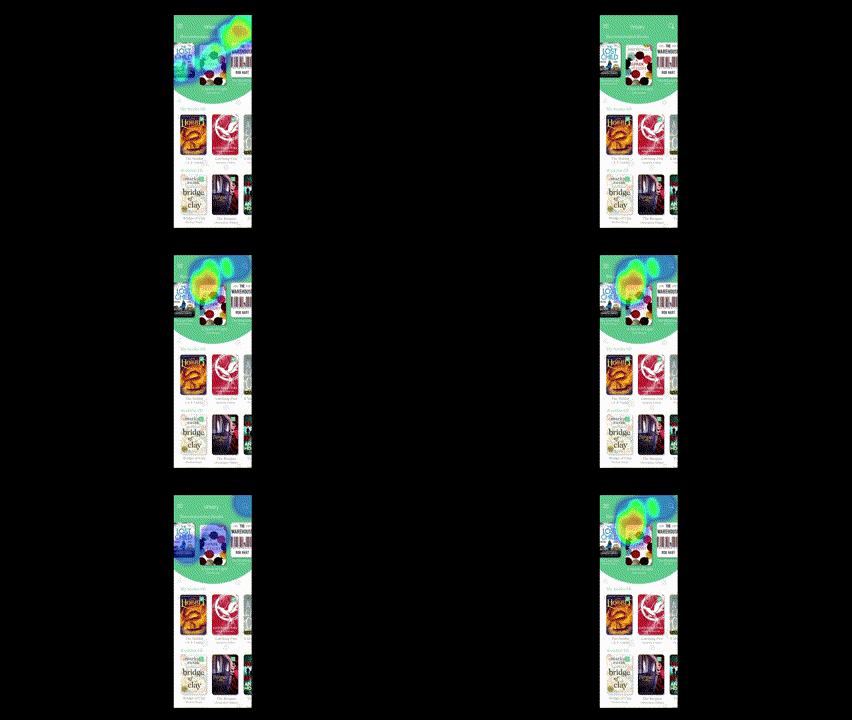
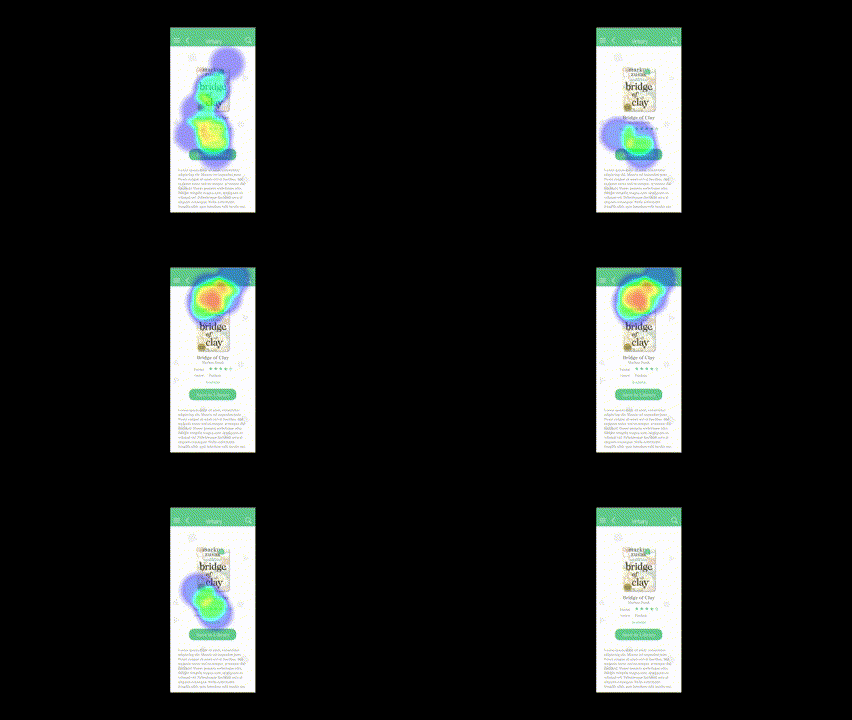
Take a look at my showcase with the final product:
JMARS Meteor Studio
Immersive VR experience to view real planetary data
Final capstone project of my undergrad/First UI VR project
JMARS is a project created from Meteor studio to use dreamscape tools to create an immersive VR experience with viewable planetary data.

Research/Ideation
As part of the development team for the JMARS Meteor Studio project, I contributed to the research and ideation process by exploring how users interact with planetary data in an immersive VR environment. Since the goal was to visualize scientific data in real time, I researched the types of information users would need to access quickly and intuitively. I also conducted a comparative analysis of a similar NASA visualization tool to better understand existing interaction patterns, data presentation methods, and opportunities to improve the VR experience. Because this was my first VR project, I spent time learning VR UI principles to understand how traditional UI concepts would translate into a VR space. This helped me design interactive scree that fit within the overall experience while making complex planetary data easier to navigate and understand.

Development/Testing
During the development phase, I designed and implemented several interactive user interfaces in Unity as part of the larger development team. Working closely with other team members, I built VR-friendly UI that allowed users to interact with and explore planetary data. Building interfaces for virtual reality challenged me to think differently about layout, readability, and interaction compared to traditional screen-based design. Throughout development, I refined the UI based on team feedback and testing, making adjustments to improve clarity, usability, and the overall user experience. This project was very unique and a great learning opportunity about how to think outside of the box

Take a look at the official Dreamscape website to learn more.

Here, you’ll find a selection of games I've designed, developed, and brought to life. From gameplay mechanics to storytelling, each project reflects my passion for creating immersive and engaging experiences. Explore the worlds I've built and the stories they tell.

Game Design Projects
Cryptic Dreamer
3D Escape Room Game with Integrated AI
First Time Managing a Project
Cryptic Dreamer is an AI integrated 3D escape room built in Unity Engine. It uses DALLE-2 for texture generation and a ChatGPT hint system.
Production
The pacing was too slow in the early stages of production so our team unanimously agreed that I take over as Project Manager and start setting deadlines for ourselves. Our vision for the game was to create a dream-like journey, seamlessly transitioning players through five distinct rooms, each more enigmatic than the last. In order to accomplish this, we created a story that flows throughout each room in the experience. The first hurdle was taking on the task for the AI generation. We focused on integrating the power of DALL·E-2 to generate unique textures and utilized ChatGPT for the generated hint system. To enhance the immersive experience, we integrated narrated UI elements and meticulously curated soundscapes, immersing players in a captivating dream-like world.
Gameplay
Players embark on a journey through five unique rooms that are similar but not quite the same as the familiar rooms of the character. As they explore, the immersive soundscape envelops them, enhancing the dreamy ambiance, while narrated UI elements provide subtle guidance without breaking the spell. The game integrates DALL·E-2's texture generation to provide a unique viewing experience throughout each playthrough. To aid in their objectives, players wield an inventory system, allowing them to collect and interact with items crucial to their escape. Notably, there is a highlight effect on vital objects, ensuring no detail goes unnoticed. Further deepening the experience, ChatGPT serves as a hint system, offering subtle nudges to keep players engaged and immersed in this ethereal escape room odyssey.

Feel free to test out the game published on Itch.io

Medieval Lands
MMO RPG Indie Game; Sequel to Eternal Lands
First Professional Design Experience
Eternal Lands was an RPG open world game released in the early 2000s. The developers are remastering it as Medieval Lands and releasing it from Unity in Spring 2024.

My Contribution
My role as a Unity software developer intern in the production of Medieval Lands, a medieval-themed RPG game, was centered on the task of transferring the emotes system and mounting system from their original engine, developed in C++, to Unity, utilizing C#. This transition required meticulous attention to detail, as I navigated the intricacies of two distinct programming languages while ensuring that the functionality integrated into Unity's framework effectively. My contributions were integral to enhancing player immersion, as the emotes system and mounting system play pivotal roles in the player's experience within the medieval world. This allows for deeper interaction and immersion in this RPG environment.
I Learned...
In my role as a Unity software developer intern I contributed to the gameplay by working on two pivotal tasks. Firstly, I tackled the emotes system, introducing a user-friendly UI dropdown list that allowed players to easily select and activate emotes. Leveraging my newfound proficiency in Unity's animator and its layers, I scripted the functionality, enabling players to trigger emotes either through the server or by typing the emote name in a text entry field. This enriched player interaction but also honed my skills in scripting and UI design. Secondly, I created the mounting system, an essential mechanic in the game for travel. When players used a whistle item, my system smoothly transitioned from their current player avatar to a mounted actor, each with the mount animator rigged for a lifelike experience. These tasks added depth and immersion to the gameplay, demonstrating my adaptability and proficiency as a Unity developer within the Medieval Lands project.

Take a look at the original game Eternal Lands

Subzero Salvation
Dreamscape Cinematic Experience in VR
First Narrated Project
Subzero Salvation is an exciting narrative experience in VR of a scientific theory of a solution to the ice caps melting in Antarctica.

Production
The creation of our immersive VR narrative experience, inspired by Kim Stanley Robinson's novel "Ministry for the Future," was a remarkable synergy of storytelling and Unity technology, all orchestrated within the Dreamscape team. In my role as a member of the Unity team, I was responsible for skillfully integrating assets, developing code, and crafting immersive user interfaces that brought this scientific theory about Antarctic ice cap preservation to life. Drawing upon Robinson's visionary exploration of climate change solutions, we embarked on a mission to engage participants in an impactful narrative, set within the immersive realm of virtual reality. This project not only paid homage to the source material but also contributed meaningfully to the ongoing global conversation about climate change, offering a tangible, immersive experience that challenged perceptions and spurred meaningful discussions about the future of our planet.
Gameplay
Within the immersive VR environment, players find themselves confined to controlled movements that allow them to follow the continuous storyline. As they navigate the frigid landscapes of the ice caps, the limited view-field compels players to remain fully engaged in the unfolding narrative, which is rich with thrilling twists and turns. By immersing themselves in the daily challenges and triumphs of these intrepid scientists, players gain a deeper understanding of the scientific theories and solutions that couple potentially hold the key to combating the ice cap melting crisis, making for an educational and emotionally resonant VR experience.

This project taught me how important collaboration is when building immersive experiences and how much small technical decisions can make a big impact. Working on the Unity team gave me valuable experience working with assets, writing code, and creating UI for a VR environment while collaborating with people on different teams to bring our shared vision to life. It also helped me better understand how storytelling and interaction design work together in virtual reality to make truly immersive experiences. Most importantly, I came away with a greater appreciation for how technology can make complex topics, like climate change, more impactful for users.
Falling Stars Z.G.S.
Multiplayer Zero Gravity Shooter
First Project
Falling Stars Z.G.S. is a multiplayer first person shooter operated through controller developed in Unity 3D. It has a split screen design for multiplayer gameplay and it is a PVP based game with a space theme.

Production
The development journey of "Falling Stars," our ambitious zero gravity shooter, was a collaboration among a dedicated team of six passionate individuals. From the outset, our unanimous decision on the game's theme and type set the stage for a space adventure. As one of the primary coders, my role was pivotal in crafting the core functionality for the game's arsenal of weapons and power-ups, working closely with my counterpart in the team to ensure responsive and efficient controls. This added an extra layer of challenge that showcased our collective skill and determination. There are still some mechanics that need fine tuning but the project has been discontinued as our group has since separated.

Gameplay
In this controller-based first-person shooter, three distinct types of guns offer strategic choices: the missile gun, packing a punch with its heavy missiles but demanding a patient reload; the regular gun, delivering a balanced blend of damage and firing rate; and the beam gun, with its rapid fire rate and consistent damage output, ideal for precision targeting. The gameplay is spiced up with two essential power-ups, one granting access to a high-damage special weapon for brief bursts of destructive potential, and the other providing a nimble speed boost to outmaneuver opponents and seize tactical advantages. There is also a sprint mechanism allowing players to swiftly navigate the zero-gravity battleground, the goal is to defeat all opponents and come out as the victor!

Through working on Falling Stars Z.G.S., Cryptic Dreamer, Subzero Salvation, and Medieval Lands, I gained valuable skills in game design, development, and storytelling. I honed my abilities in creating immersive environments, developing gameplay mechanics, and integrating AI. Working across different platforms, from VR to MMO RPGs, I also strengthened my proficiency in prototyping, level design, and enhancing player experiences. These projects deepened my understanding of narrative-driven gameplay and multiplayer dynamics, preparing me to tackle diverse challenges in the design field.